


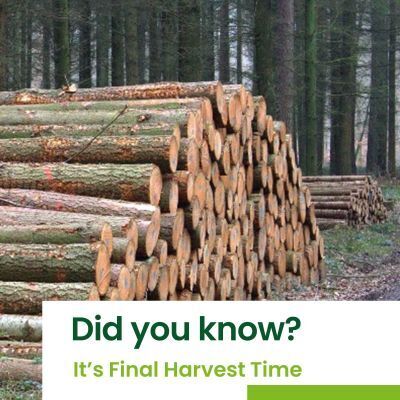

It’s final harvest time when pine trees between the age of 30 to 35 years are harvested to become the logs that provide the majority of South Africa’s building material for construction and the furniture trade.
30-35 is the ideal age to harvest but in practice harvesting often takes place sooner due to factors like timber shortages and fires.
Pine logs are felled and processed into lengths by a mechanical harvester – this operation takes place infield or on the roadside before the timber is transported to the sawmill. Once the logs arrive at the log yard/sawmill, they are grouped into several log bays where they are scanned for size and shape. The scanning information is fed to the IT system that runs the sawing operation, which is overseen by the saw operator, a highly skilled individual who often detects nuances in the logs that the IT system cannot see.
Before entering the mill, the logs are washed with water to rinse off the debris that can damage the saw blades and equipment. The logs are then sawn into several dimensions with the most popular being 25mm, 38mm, 50mm and 76mm in thicknesses and 102mm, 114mm, 152mm and 228mm in width.
Once these logs are turned into planks through different custom saw patterns, the timber gets moved by conveyors to the green chain. The green chain is a type of lumber-sorting process first used in the early 1900s to sort and stack freshly cut lumber according to its size and grade. In most green chains in South Africa, planks of similar dimensions are sorted by hand onto giant trolleys from where they are moved into the kilns to be dried.
This drying process will be discussed in our next Did You Know blog.


 Comalytics