


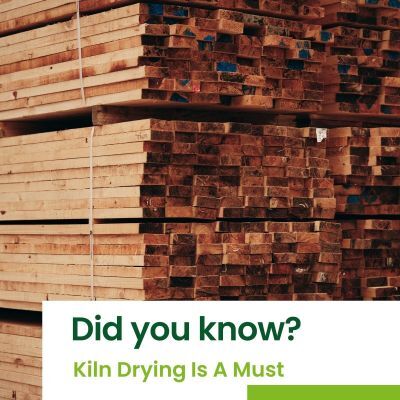

Kiln drying is a critical process in the pine production journey to the extent that the success of a sawmill and its operation is judged on its ability to dry timber to optimum levels.
What is Kiln Drying?
Kiln drying extracts moisture from felled logs after they have been cut into various plank dimensions. A long and gradual process that can take days or weeks depending on the thickness of the timber, kin drying involves the movement of air through the kiln from one direction to another. At the same time, relative humidity and temperature are tightly controlled in order to gradually reduce the moisture content in the timber without causing defects such as cracking, bowing or twisting.
Why is Kiln Drying Important?
Timber interacts with moisture in the environment with varying humidity levels of the surrounding air causing wood to gain or lose water moisture and as a result, expand or contract. This affects the stability, look and longevity of the wood.
Wood has reached its Equilibrium Moisture Content (EMC) when it neither gains nor loses moisture. Kiln drying accelerates the EMC of wet timber which means that:
- The wood can withstand changes in external temperature and will make the finished product last longer.
- The timber has a better chance of withstanding pests and fungi
- The timber will machine better and perform better when installed as it is inherently more stable.
- The timber is more uniform, and the lighter weight makes it more cost-effective to transport.
Kiln Drying Processes
There are two main kiln drying processes used in South Africa:
- Chamber/Compartment kilns
The timber stacks are loaded into the chamber and closed on both sides. Although this method provides more precise and individualised drying solutions, it is more time-consuming and expensive to run and requires more skilled operators. - Progressive kilns
The timber stacks continuously move through the kiln as it is open on two sides. This allows for higher volumes of timber at a faster throughput rate. This in turn means lower operating costs and less skill to manage.
Kiln drying is a critical process and a crucial stage in the life of timber. If done correctly it will enhance the timber and add critical value to the product but done incorrectly 35 years of growth is wasted and expensive firewood is created.
Read more about the journey of timber as described by Ian Burger in his Did You Know blog series.


 Comalytics