


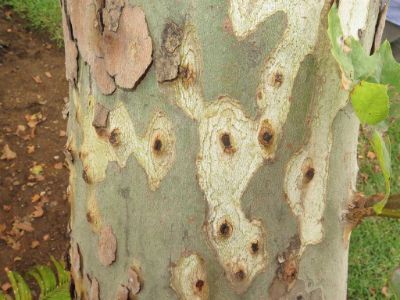

The City has issued a shot hole borer warning to Capetonians after a tree on a private property in Newlands was found infested with the invasive beetle. Concern has grown to such an extent that the City has called an On-Line Meeting on Tuesday, 7 February starting at 18:30.
“At this online meeting, officials from our Invasive Species Unit will give important information on how to identify possible infestations, where to report it, and how to handle the chipped biomass. I urge residents to please attend this online meeting if possible, and to help us beat the beetle,’ said the City’s Deputy Mayor and Mayoral Committee Member for Spatial Planning and Environment, Alderman Eddie Andrews.
According to the latest update on the City of Cape Town website, the alarm was sounded when a Boxelder tree infested with the invasive Polyphagous Shot Hole Borer beetle (PSHB) was discovered on a private property in Newlands on 24 January 2023. Since then:
- The Invasive Species Unit has been conducting assessments in the Newlands, Rondebosch, Mowbray and Claremont areas.
- The Liesbeek River has been identified as a priority pathway, and the City has allocated resources to conduct assessments to determine the extent and distribution of the beetle in the area
- The City will soon commence with the removal of infested trees on City-owned land such as public open spaces, river corridors, green belts, road verges, public parks
Andrews encourages property owners to heed the shot hole borer warning and inspect trees on their own grounds urgently and to report sightings to the City as soon using the following channels:
- Online, at www.capetown.gov.za/InvasiveSpecies
- Call the City of Cape Town’s Invasive Species Unit on 021 444 2357, Monday to Friday, from 07:30 to 16:00
- Send an email to: invasive.species@capetown.gov.za
The beetle is the size of a sesame seed, approximately 2mm in length and poses a threat to both exotic and indigenous trees across South Africa. The alien trees that have been infested include London plane trees, Liquidamber, Japanese maples, Chinese maples, pin oaks and English oaks, while the indigenous trees include the Coast Coral tree, Forest Bushwillow and the Cape willow.


 Comalytics